Showing posts with label Review. Show all posts

Thursday, July 28, 2011

Somewhere - Review


Sofia Coppolla’s fourth film is the second from her own screenplay and, while it shares Lost in Translation’s DNA – a bored, semi-famous movie star (Johnny Marco, played by Stephen Dorff) hangs around a hotel (in this case, hotels) pondering his place in life while doing not much with a younger woman (this time, his daughter Cleo, played by Elle Fanning) – it is very much its own film, with its own concerns and, regrettably,  its own flaws.

Coppolla's direction is perfectly controlled, but her script lets her down. Through the pace of the editing, the composition of her shots and the general lack of her usual hipster cool soundtrack, Coppola manages to richly express her characters. The problem is that her characters are not much fun to watch - Dorff's Johnny Marco is a frustratingly hollow man, while the talented Fanning's Cleo is vague and underwritten.

The opening shot explains everything that is at once brilliant and frustrating about Coppola's latest exploration of celebrity alienation - a stationary shot of Johnny Marco's black Ferrari drives in and out of shot as he circles an abandoned racetrack - over & over & over & over & over & over & over again. Not at an exceptional speed, and with no one watching or cheering him on.

As a methaphor for Johnny's life, the opening shot could not be more effective; a fancy sports car, but no joy whatsoever. Just when you think Coppola can't possibly make you watch Johnny going around the track any more, she does. A few more times. It's powerful film making; as frustrating to watch as it must be to be Johnny, but making a film so committed to the boredom of its lead character has an obvious pitfall; it can be difficult to enjoy. And that is where Coppola's script & characters fails to provide the payoff needed to make the journey worthwhile.

Coppola's pacing traces the (minimal) development of Johnny and Cleo's relationship, but her technique is more intriguing than the actual characters.

Before Cleo arrives, scenes are shot in long, exhaustive takes with only diegetic (in-scene) music, and not Coppola's usually hipster cool music at that. While Johnny's life does not lack event, it certainly lacks emotional engagement, and so does the film, which is a beautiful illustration, but at times a difficult one to sit through. But that is Johnny's life.

Once Cleo arrives, the pace gradually picks up and the not much that happens takes on a somewhat lighter, less claustrophobic tone. In my opinion, though, the scene chronicling a game of Wii tennis takes it one step too far, but perhaps others may find it refreshing.

It's only once Johnny & Cleo have finally started to grow comfortable around each other - minus much  talking, mind you - & decide to spend a last day together before Cleo goes to Summer camp, that Coppola allows the editing & soundtrack to flow, setting a sweetly joyful montage of father / daughter poolside bonding to The Strokes' smashing I'll Try Anything Once.

But the surfacing of Johnny's feelings lead only to a solitary, self-loathing breakdown which is powerfully written and performed, but somehow feels forced an inorganic. And after hours of hanging around looking smart, shy & laid back cool, Fanning's Cleo is also allowed an out-of-the-blue, although justified, emotional catharsis, to which Johnny responds with a blank stare and awkward muttering.


When Johnny bids Cleo farewell, he is only able to express any kind of love for her when drowned out by the roar of a helicopter. Although a beautiful expression of Johnny's inertia, it is hard to care, after so much time, about a bored, self-indulgent movie star who makes no effort to enjoy his life, know himself or contribute anything of value to his daughter, even when she is begging for just one of her parents to make her a priority.

After Cleo is gone, Johnny's purposelessly mopey ways threaten to overtaken again. A shot of  Dorff's head slowly being cut out of frame as he floats lethargically on a li-lo was apparently unplanned, but is nevertheless pure perfection.

The enigmatic final reel, set to Phoenix's stirring Love Like a Sunset Part II, effectively revisits the Ferrari metaphor, but by this point, the journey taken with Johnny to get there feels exhausting rather than enriching. It is a poetic coda to a dry & measured film.


Saturday, June 4, 2011

Jane Eyre - Review

Charlotte Bronte's Jane Eyre has been adapted for the screen no less than 20 times, so one may wonder why Cary Fukunaga (2009's Sin Nombre) has made another. 


Track it down, though, & be grateful that he did.


As quietly tense & gloomy as the poster suggests, Fukunaga's adaptation is an artful, unhurried piece of cinema perched somewhere between Hitchcock's Rebecca and Campion's The Piano. 


Screenwriter Moira Buffini plots out Charlotte Bronte's substantial plot with a flashback structure that lends a sense of foreboding and inevitability to Jane's story, and the technical elements, from the period costumes and sets, to Dario Marianelli's sumptuous, awards-worthy score, are top notch. But the highlight is Adriano Goldman's misty, smoky, often candle-lit cinematography, casting a sense of perpetual possibility over the whole film.  


Jane Eyre is essentially a character study and a fairly heavy social commentary on the limited opportunities and value of women and the working class in nineteenth century England, but it is also a gothic mystery, and is at its best as an unconventional love story.  


Mia Wasalowski (interpreting another classic literary incarnation after Tim Burton's Alice in Wonderland) stretches herself as Jane, restricted by the boundaries drawn for her by society, and withdrawn due to love that was withheld from her, but refusing to quieten the passion & unconventionality within. A passionate and strong-minded heroine unsure of her future, director Fukunaga's style allows her time to explore Jane's moods & inner world beyond the constrains of the plot. 


Wasalowski is young, though, and at times the depth of the character feels more acted out than genuine, as if Wasalowski cannot quite carry the full weight of Jane's life, but it is nevertheless a strong performance and, in its best moments, a startlingly powerful one. 


What brings out the true power in Wasalowski's performance is her co-star, the ever-brilliant Michael Fassbender, as the cold and eccentric Rochester. Fassbender's creation is a truly original one that feels like it couldn't possibly be improved on. He feels fully in command of Rochester's every word and gesture, and brings a sharpness and vitality to him that is at once off-putting and alluring. One of the male performances of the year.


The chemistry between Jane and Rochester is electric, while their conversations are never less than thrillingly unpredictable. He is erudite, confrontational & wildly enigmatic, while she is refreshingly direct, otherworldly and egoless.  


This is no lace and love letters period romance, it is a dark and broody tale of two very unlikely people drawn into a strange and complex courtship with a hard-earned conclusion. Their central relationship fuels the film with an offbeat pulse.


I have never read the book, so I can't vouch for the faithfulness of the adaptation, but Fukunaga's film is a fully formed piece of cinema that never feels rushed or incomplete, and manages to sustain its dreamy mood and and authenticity through major plot and genre coils.


But, of course, one cannot review a movie starring Judi Dench without reviewing Judi Dench. Dame Judi plays Mrs Fairfax, Rochester's devoted, if simple-minded, housekeeper - who believes that the answer to Jane's yearning for the adventures of men - is fresh air & physical exercise. With Judi Dench it is never a question of good or bad, but rather of good or Oscar-worthy. Here she is very good, but not Oscar-worthy. She admirably takes quite a backseat to the passion of the central relationship, but naturally commands attention and brings nuance in all her scenes.  


All in all highly recommended.


Short clip - Mia Wasalowski, Judi Dench & Adriano Goldman's camera work:


Wednesday, April 27, 2011

Blue Valentine - Review

I saw Derek Cianfrance's Blue Valentine a few weeks ago, and had so much to say about it, but it took my a while to get around to finishing my review.  


Before getting into the heavy stuff, the film is, aesthetically, beautiful. Andrij Parekh's loose camera work is gorgeous and draws you into the chaos and intimacy of Dean & Cindy's marriage.


Director Derek Cianfrance wanted Brooklyn band Grizzly Bear to write a score for his film. 


Scheduling problems ruled that out, but Grizzly Bear did the next best thing & handed him their entire catalogue of music to use as he pleased. As a result, the bulk of the film is still underscored by the indie cool of the Brooklyn music scene. 


These stylistic touches contribute to the swooning beauty of the outsider love story and help make the heavier parts easier to swallow.  

As for the heavy stuff, there's plenty of it. Without divulging too much plot, Blue Valentine looks at two pivotal moments in a young marriage - when it began, and when it is in danger of falling apart.

How it begins is an intense swirl of indie cool and bruised adolescence where two damaged people find each other and - under less than ideal circumstances - decide to stick together. How it falls apart is like Who's Afraid of Virginia Woolf with indie kids - no big infidelities or secrets, just the small frustrations that become overwhelming. Heartbreaking stuff.  


It's not an easy film to watch - it is raw, unflinchingly honest and refuses to choose sides. Both characters wear their pain on their sleeves and what initially brought them together threatens to tear them apart when they are unable to put it aside for the sake of their marriage. The joy is mapped out in as much complex detail as the misery. 


Much has been made of the film's sex scenes, but Ryan Gosling & Michelle Williams give performances so real & vulnerable, it feels like they are holding their souls up for scrutiny. In that context, there is nothing in the sex scenes that is any more revealing or uncomfortable to watch than in their fully-clothed conversations. Additionally, as in any marriage, the dynamics of the sex scenes are pivotal to revealing their state of intimacy, and, though uncomfortably real, the scenes are certainly not intended to be gratuitously erotic.     


It is a testament to the actors' commitment to their characters that their turmoil is so riveting to watch - these two lost souls feel so real, and their frustrations so palpable, you desperately want to pull them aside and talk them through it.


Blue Valentine is probably best viewed as a cautionary tale about letting your emotions get the better of you. By allowing us to see what their marriage becomes, and also how it started, we are able to see the seeds of what comes between them in the end - whether it's Cindy's fragile & withdrawn nature, or Dean's volatile bullheadedness, what was sweet & charming to them at the start becomes unbearable when they can't get past their own insecurities to be good to each other.

The heartbreak of the film is to learn to face up to the small things in each of our lives that can get the better of us, if we let them, and push away the people and things we love and need the most. 


One of the best written and best acted films of the year. 


Grizzly Bear - Easier, featured in Blue Valentine.


& Penny & the Quarters - You & Me - Dean & Cindy's song:

Sunday, March 27, 2011

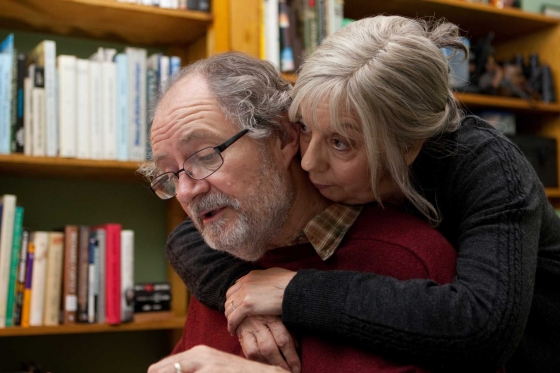
Another Year - Review

Finally got to see this.

It's a pity I was so tired, because it is heavy on dialogue, low on plot and, although it's slow and quiet, you really don't want to miss a moment.

Mike Leigh's writing is as excellent as ever - observing complex truths about choices, consequences and happiness, but always letting the observations serve the characters, not the other way around.

Every character is complexly written and every single member of the cast performs miraculously - this group of friends feels so real and the quietly shifting emotions, tensions, loyalties and perspectives in their conversations are beautifully observed.


Jim Broadbent & Ruth Sheen anchor the film with spot on performances as Tom & Gerri, the stable, happy couple to whom a series of desperate, messy friends flock. Oliver Maltman brings wit and goofish charm as their son and Karina Fernandez is a mad blast as his perfectly matched girlfriend.

But it is Lesley Manville (Cannes & National Board of Review Best Actress winner) & Imelda Staunton that steal the film as two very different, bitter and chronically unhappy women that Gerri tries to get through to but possibly can't. The finale centers around Manville's Mary, and her performance is so fearless and glamourless, that it is at times difficult to watch - a manically energetic, skittish woman who never stops talking, cannot get over the hurts love and life have dealt her, will fall for (almost) any man who gives her attention, thinks she is successfully masking her unhappiness, cannot buy a decent second-hand car or take care of her garden and deeply wants to be someone her friends can confide in. She is as hilarious as she is heartbreaking, and at times downright poisonous and pathetic. It's a brave and bruising performance.


The film quietly poses questions about why some people are happy while others never seem be; why some people simply seem to make better choices; how to make someone see their own folly; whether it's selfish to enjoy the happiness of your own successful life while others can't seem to get theirs together & what can actually be done to help them? It poses no answers, but provides much richly detailed food for thought.

A tour-de-force of great ensemble acting & writing (it is ensemble writing, as Mike Leigh develops his scripts together with his cast).

Saturday, March 26, 2011

Red Riding Hood - Review


Friends made me watch this on Human Rights Day because I made them watch Tron: Legacy (how is that fair?).

It is a pile of poo. I can only assume that once-promising director Catherine Hardwicke (Thirteen, Lords of Dogtown) enjoyed making some money with Twilight, and was eager to repeat her success. She should be eager to get back to her legitimate career.

Red Riding Hood borrows heavily from Twilight to appeal to the pre-teen-but-think-they're-teen girl audience:

  • Soulful, life-changing voiceovers - check
  • Involuntary attraction to a sensitive bad boy - check
  • Forests - check
  • Lots of heavy breathing - check
  • Pretty girl with family issues torn between two pretty boys - check
  • Werewolf - check
  • Billy Burke as 'dad' - check
  • Terrible romantic dialogue ('I know you feel it too - like you're burning inside...' '...I want to eat you up...') - check

I guess its entertaining enough, and it holds some surprises, but mostly its a good unintentional laugh (and I wasn't the only one in the cinema chuckling). Gary Oldman does his worst work in a while, and the great Julie Christie embarrasses herself for what must be a much-needed paycheck.

It's pretty much a stinker.